Combined effects of meltwater and crystallographic orientations control radar reflections in temperate ice
Abstract
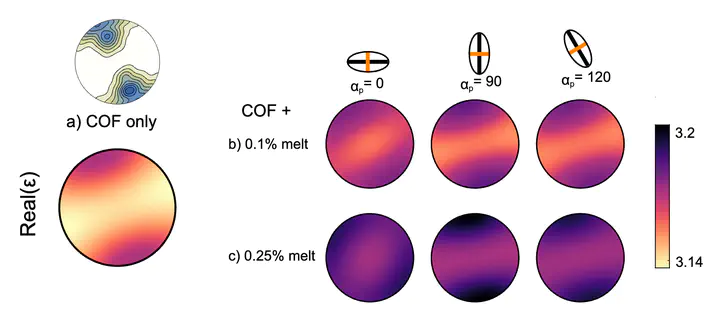
Polarimetric radar surveys rely on principles of solid material alignment to interpret ice flow. However, interstitial meltwater also aligns during deformation, creating melt preferred orientations (MPOs) reflecting current conditions. Here, we model the effects of MPO development on radar anisotropy in temperate icy masses. We find that 0.1% by volume of oriented meltwater is sufficient to modify anisotropy created by solid crystallographic orientation fabrics (COFs), and that MPO variations at 1% by volume induce permittivity anisotropy over nine times greater than that from COF strengthening alone. Additionally, the effect of co-aligned COF and MPO can increase permittivity anisotropy signatures by 69% compared to an MPO without background COF, but misaligned MPO and COF produce similar anisotropy to that from MPO alone. This suggests that COF enhances MPO signatures in permittivity anisotropy, not the other way around, and that COF-based radar interpretations may overpredict subsurface ice flow in temperate regions.