Resolving radiostratigraphy with squinted synthetic aperture radar focusing
Abstract
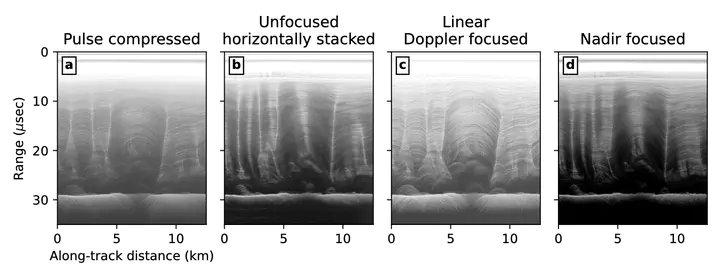
Englacial layers are a product of historic accumulation and are reshaped by ice deformation. Hence, radio-echo sounding (RES), which can resolve englacial layering, has been adopted as an observational tool to infer ice age and ice dynamics from ice stratigraphy. However, the commonly applied synthetic aperture radar focusing algorithms, used to improve image resolution, are either i) incoherent, or ii) optimized for the ice-bed interface. Dipping specular reflectors, such as englacial layers, are then lost during focusing. Instead, we focus the RES measurements using subapertures, synthetically squinting the radar beam toward orthogonal incidence for every dipping layer. We then either recombine all subapertures, or reject those with low signal, to generate an image which resolves all englacial targets together. We apply these methods to both along- and across-flow RES images at Academy Glacier, East Antarctica, which has significant englacial layer relief, especially perpendicular to the ice-flow direction. Our method significantly elevates signal power for dipping englacial layers ($>$15 dB), and quantifiably improves layer continuity compared to other processed data products. This squinted focusing approach enables novel studies of ice deformation (as recorded in englacial layering) in the presence of complex basal topography and heterogeneous substrate properties.