Anisotropic melt inclusions as a confounding signal for ice-penetrating radar observations
Abstract
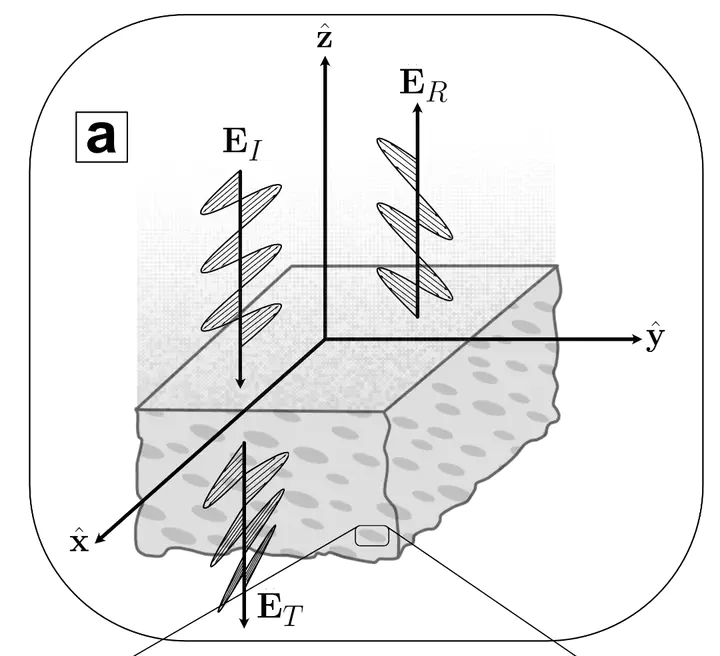
Ice-penetrating radar is a powerful geophysical tool for understanding the subsurfaces of Earth, Mars, and icy moons. Radar reflectivity, attenuation, and birefringence are used to infer subsurface hydrology, englacial temperature, water content, and crystal orientation fabric. However, conventional radar sounding analyses rely on classical mixing models which assume spherical melt inclusions, obscuring anisotropic contributions of melt. Here, we use geometric mixing models to calculate the reflectivity, attenuation, and birefringence of temperate ice containing anisotropic melt. We find that that anisotropic melt can introduce significant deviations in radar measurements. For instance, melt anisotropy may impact reflectivity-based estimates of water content by up to 30% volume fraction, while attenuation-based estimates may vary by up to 43%. Critically, a melt volume fraction of just $f\sim10^{-5}$ can reproduce birefringence signals previously attributed solely to ice fabric. We conclude that melt anisotropy may significantly impact analyses of englacial hydrology, subglacial hydrology, and ice fabric.